1934 Copy You Cant Go Home Again
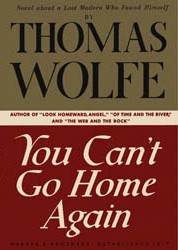 Starting time edition cover | |
| Editor | Edward Aswell (edited and compiled work from writings of Wolfe, published posthumously)[1] |
|---|---|
| Author | Thomas Wolfe |
| Genre | Autobiographical fiction, Romance |
| Published | New York, London, Harper & Row, 1940 |
| Pages | 743 |
| OCLC | 964311 |
You Can't Go Home Again is a novel by Thomas Wolfe published posthumously in 1940, extracted by his editor, Edward Aswell, from the contents of his vast unpublished manuscript The Oct Off-white. It is a sequel to The Web and the Rock, which, along with the collection The Hills Beyond, was extracted from the same manuscript.
The novel tells the story of George Webber, a fledgling author, who writes a book that makes frequent references to his abode town of Libya Loma which was really Asheville, N Carolina. The volume is a national success but the residents of the town had been unhappy with what they view as Webber's distorted depiction of them, send the author menacing letters and death threats.[2] [3]
Wolfe, as in many of his other novels, explores the changing American society of the 1920s/30s, including the stock market crash, the illusion of prosperity, and the unfair passing of time which prevents Webber ever being able to return "home once more". In parallel to Wolfe's relationship with the Us, the novel details his disillusionment with Federal republic of germany during the rise of Nazism.[iv] [5] Wolfe scholar Jon Dawson argues that the two themes are connected most firmly by Wolfe'southward critique of commercialism and comparison between the rise of capitalist enterprise in the United states of america in the 1920s and the rising of fascism in Germany during the same period.[6]
The artist Alexander Calder appears, fictionalized as "Piggy Logan".[7]
Plot summary [edit]
George Webber has written a successful novel nigh his family unit and hometown. When he returns to that boondocks, he is shaken past the strength of outrage and hatred that greets him. Family unit and lifelong friends experience naked and exposed past what they accept seen in his books, and their fury drives him from his domicile.
Outcast, George Webber begins a search for his own identity. It takes him to New York and a hectic social whirl; to Paris with an uninhibited group of expatriates; to Berlin, lying cold and sinister under Hitler's shadow. The journey comes total circle when Webber returns to America and rediscovers information technology with honey, sorrow, and hope.
Title [edit]
Wolfe took the title from a conversation with the writer Ella Wintertime, who remarked to Wolfe: "Don't y'all know you lot can't go home once again?" Wolfe so asked Winter for permission to use the phrase as the title of his volume.[8] [9]
The title is reinforced in the denouement of the novel in which Webber realizes: "You can't go back home to your family, back abode to your childhood ... back dwelling house to a beau's dreams of glory and of fame ... back domicile to places in the country, back dwelling house to the old forms and systems of things which one time seemed everlasting, but which are irresolute all the time – dorsum home to the escapes of Time and Retentivity." (Ellipses in original)[10]
References [edit]
- ^ You Can't Go Habitation Once again. OCLC Worldcat. OCLC 964311.
- ^ "You lot Can't Become Domicile Once more". Magill Book Reviews. 15 March 1990.
- ^ Strauss, Albrecht B. (Jump 1995). "Yous Tin can't Go Home Over again – Thomas Wolfe and I". Southern Literary Journal. 27 (2): 107–116.
- ^ Godwin, Rebecca (2009). "'You Can't Go Home Again': Does Nazism Actually Transform Wolfe's Romanticism?". Thomas Wolfe Review. 33 (1/2): 24–31.
- ^ Hovis, George (2009). "Across the Lost Generation: The Death of Egotism in 'You Tin can't Get Habitation Again.'". Thomas Wolfe Review. 33 (2): 32–47.
- ^ Dawson, John (2009). "Look Outward, Thomas: Social Criticism as Unifying Chemical element in 'You Can't Become Abode Once more.'". Thomas Wolfe Review. 33 (i/2): 48–66.
- ^ Shattuck, Kathryn (October 10, 2008). "From a Big Imagination, a Tiny Circus". The New York Times . Retrieved Jan eleven, 2014.
- ^ Fred R. Shapiro, ed. (2006). The Yale Book of Quotations. New Haven, Connecticut: Yale University Printing. p. 832. ISBN978-0-300-10798-2.
- ^ Godwin, Gail (2011). "Introduction". Yous Tin can't Go Home Again. Simon and Schuster. p. xii. ISBN9781451650488 . Retrieved 2013-03-05 .
- ^ Madden, David (2012). "'Y'all Can't Become Home Once more': Thomas Wolfe's Vision of America". Thomas Wolfe Review. 36 (1/2): 116–126.
External links [edit]
- You Can't Go Home Again at Faded Folio (Canada)
- Transcript of interview with Susan J. Matt, To The Best Of Our Knowledge radio
Source: https://en.wikipedia.org/wiki/You_Can%27t_Go_Home_Again
0 Response to "1934 Copy You Cant Go Home Again"
Post a Comment